Braai guide · 6 min read
Wood, charcoal or gas
They are not three grades of the same thing. Each one gives you something the others cannot, and takes something away.
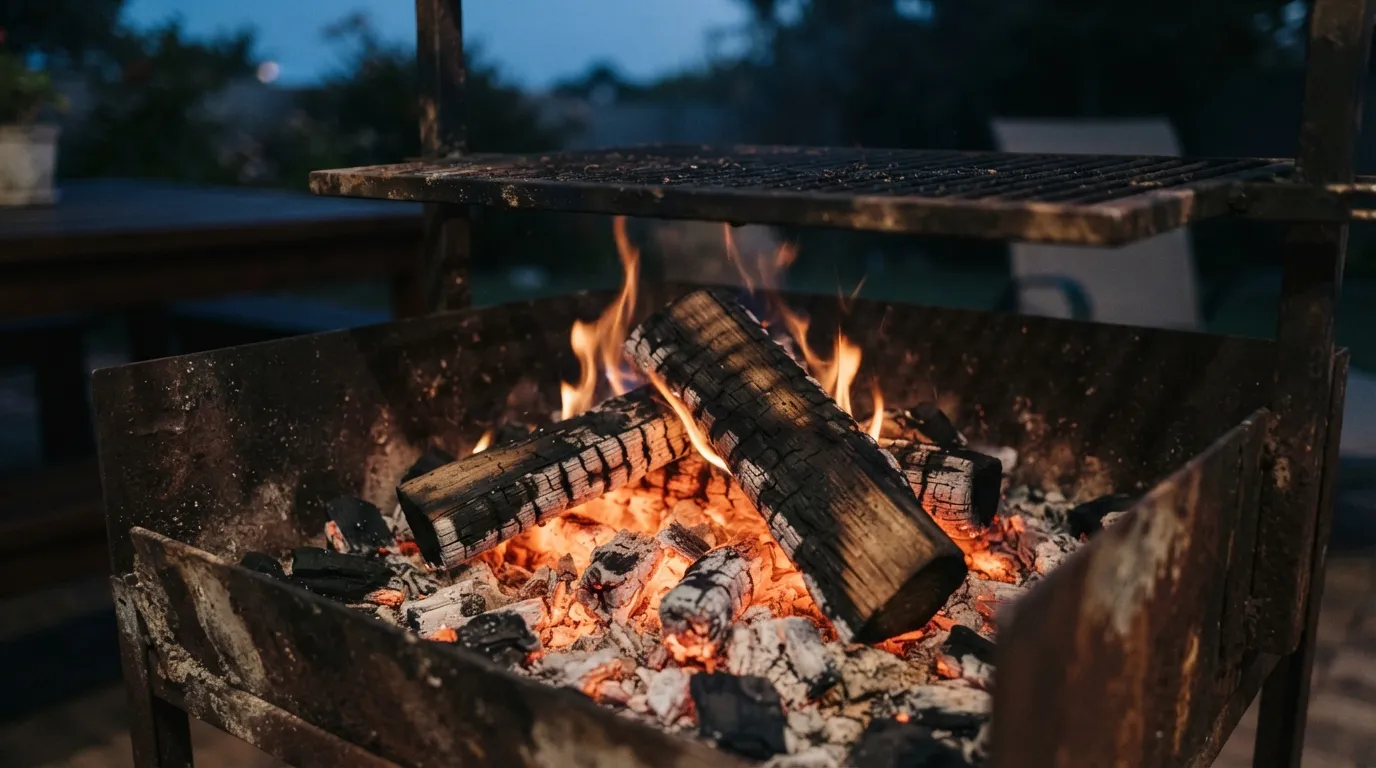
Most arguments about this are really arguments about time. Wood takes the longest and gives the most. Gas takes no time and gives the least. Charcoal sits in the middle and is, for most people most weekends, the sensible answer. Knowing which you are choosing — and why — matters more than which one you land on.
Wood
Wood is the only one of the three that puts flavour into the food. Smoke from hardwood carries compounds that settle on the surface of the meat while it cooks, and that is the taste people mean when they say something tastes like a braai rather than like a grill.
The cost is an hour. You are not cooking on wood; you are cooking on what wood becomes. A wood fire needs to burn down until the flames have gone and you are left with glowing coals under a layer of grey ash. Rushing that is the single most common reason a braai goes wrong: flames scorch the outside of the meat while the inside stays raw, and the fat dripping down feeds the flames, which makes it worse.
Wood also gives you a heat you can move. A big fire burned down leaves you a bed of coals you can rake thick on one side and thin on the other, which is how you cook chops and chicken on the same grid without burning one and undercooking the other.
Plan for 45 to 60 minutes between lighting a wood fire and putting anything on the grid. If people are arriving at seven, the fire is lit at six.
Charcoal
Charcoal is wood that has already been through the burning-down part. It has been heated in a low-oxygen kiln until the water and most of the volatile compounds are driven off, leaving almost pure carbon. That is why it lights faster, burns hotter and produces far less smoke than wood: the smoky part has already happened, somewhere else.
You get most of the heat control of wood in about twenty minutes, and you give up most of the flavour. Lump charcoal — irregular chunks that still look like pieces of wood — keeps a little more of it, lights faster and burns hotter than briquettes. Briquettes are charcoal dust compressed with a binder: they are more uniform, burn longer and more evenly, and are easier to judge if you are new to it.
For a weekday braai, or for anything where you want to be eating within half an hour of deciding to eat, charcoal is the right tool and there is nothing second-rate about it.
Gas
Gas is a cooker that lives outside. It gives you immediate, adjustable, repeatable heat, it turns off when you turn the knob, and it adds no flavour of its own whatsoever. The flame is burning clean, so there is nothing in the smoke to settle on the food, because there is barely any smoke.
That is a real advantage in a few situations and worth owning honestly: a flat with a balcony where an open fire is not allowed or not wise; a fire ban, which much of the country gets every dry season; cooking for small children who need to eat at a fixed time; and anything you want to be able to stop instantly.
What gas cannot do is give you a bed of coals with hot and cool ends, and it cannot give you the taste. If somebody tells you their gas braai tastes like a wood one, they are either using a smoker box or being polite.
Side by side
| Wood | Charcoal | Gas | |
|---|---|---|---|
| Ready in | 45–60 min | 20–30 min | 5 min |
| Flavour | The most | Some | None |
| Heat control | By raking coals | By raking coals | By a knob |
| Best for | A long afternoon | Most braais | Fire bans, flats, a fixed dinner time |
| Worst at | Being quick | Very long cooks | Tasting of anything |
What most people should actually do
Keep charcoal for the braais that happen because somebody suggested it an hour ago. Burn wood when the braai is the afternoon rather than the meal — when people are arriving at four to eat at seven and the fire is part of the point. Use gas without apology when there is a fire ban or when you are cooking on a balcony.
And if you want the best of the first two: build a wood fire, and when it has burned down, top it up with a few lumps of charcoal. You get the flavour from the wood and a longer, steadier bed of coals from the charcoal. That combination is what a lot of people who braai every week quietly do.